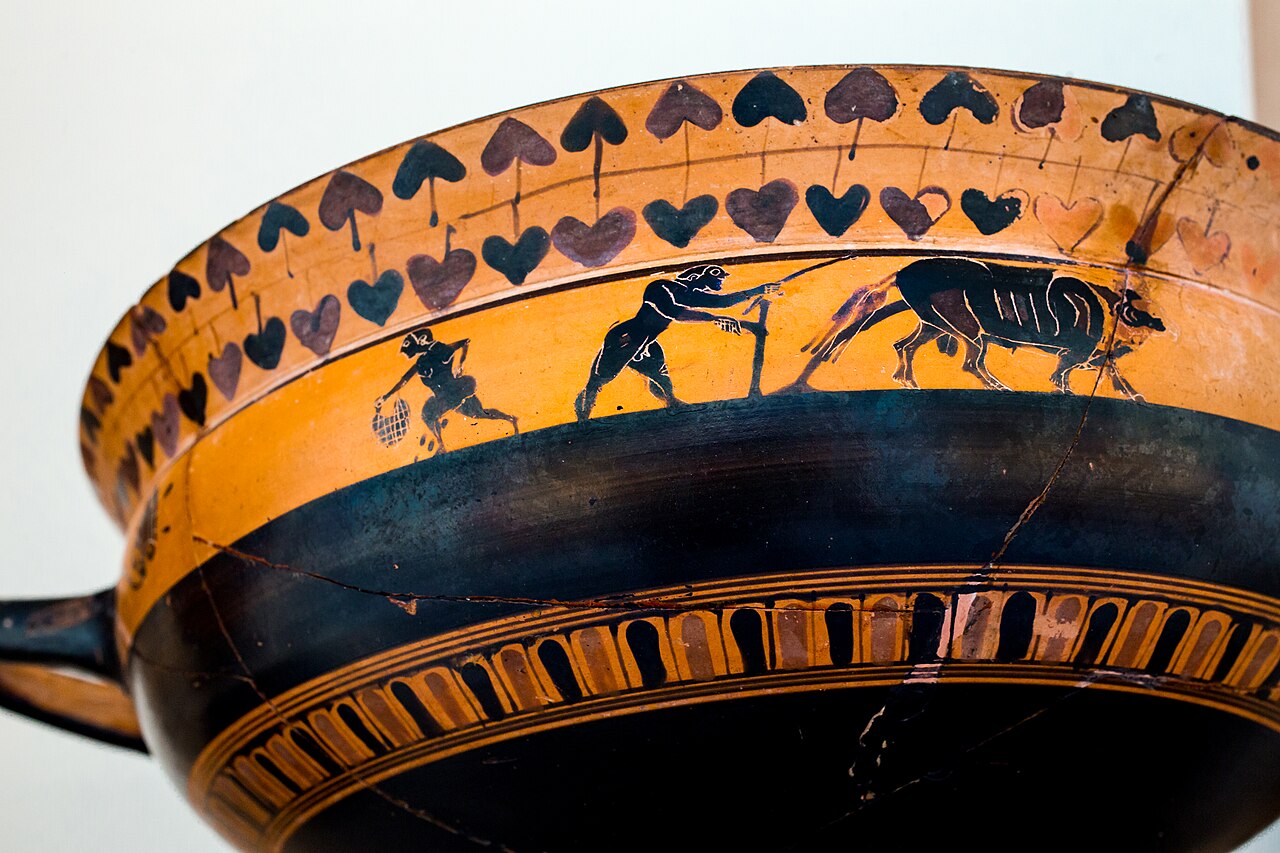
The Thriasian plain, the flat farmland behind Eleusis, was full of ploughing today. Pairs of oxen leaned into their yokes, men walked behind them holding the ploughs steady, and boys followed with bags of seed at their hips, throwing it out in wide handfuls. The turned earth was dark and wet and smelled sweet. At the edge of one field a farmer with no oxen was breaking the ground with a hoe, alone.
Cranes came over in the afternoon, so high that I heard them before I found them, a long wavering line crying across the sky. Every farm boy in Attica knows the verse of Hesiod, the old farmer-poet of Boeotia, that the crane crying from the clouds means it's time to plough. Hesiod also says the same cry grieves the heart of the man who has no oxen. I looked back at the man with the hoe, still bent over his field.
After the plain I climbed for the rest of the afternoon, until I came out into the high plain of Oinoe, a small valley of its own with fields, scattered farms and smoke rising from the village. Glaukos, a farmer of Oinoe, let me sleep in his house for a few small coins, and the donkey got a corner of his yard and an armful of straw.